What I brought to WEC, what WEC gave me back, and the one lesson that tied everything together: response is where leadership lives.
The day before one of our sessions at MPI's World Education Congress in San Antonio, my hotel lost water.
Mine. In the middle of Texas heat. In the middle of a global conference. Along with so many of my colleagues who were staying in the same place, trying to do the same thing: show up and do our best work.
Nobody planned for that. Nobody scheduled it into the agenda. It just happened, the way real life tends to do when you're in the middle of the most important week of your professional year.
And honestly? It was the perfect setup for what came next.
What a crisis teaches you about leadership
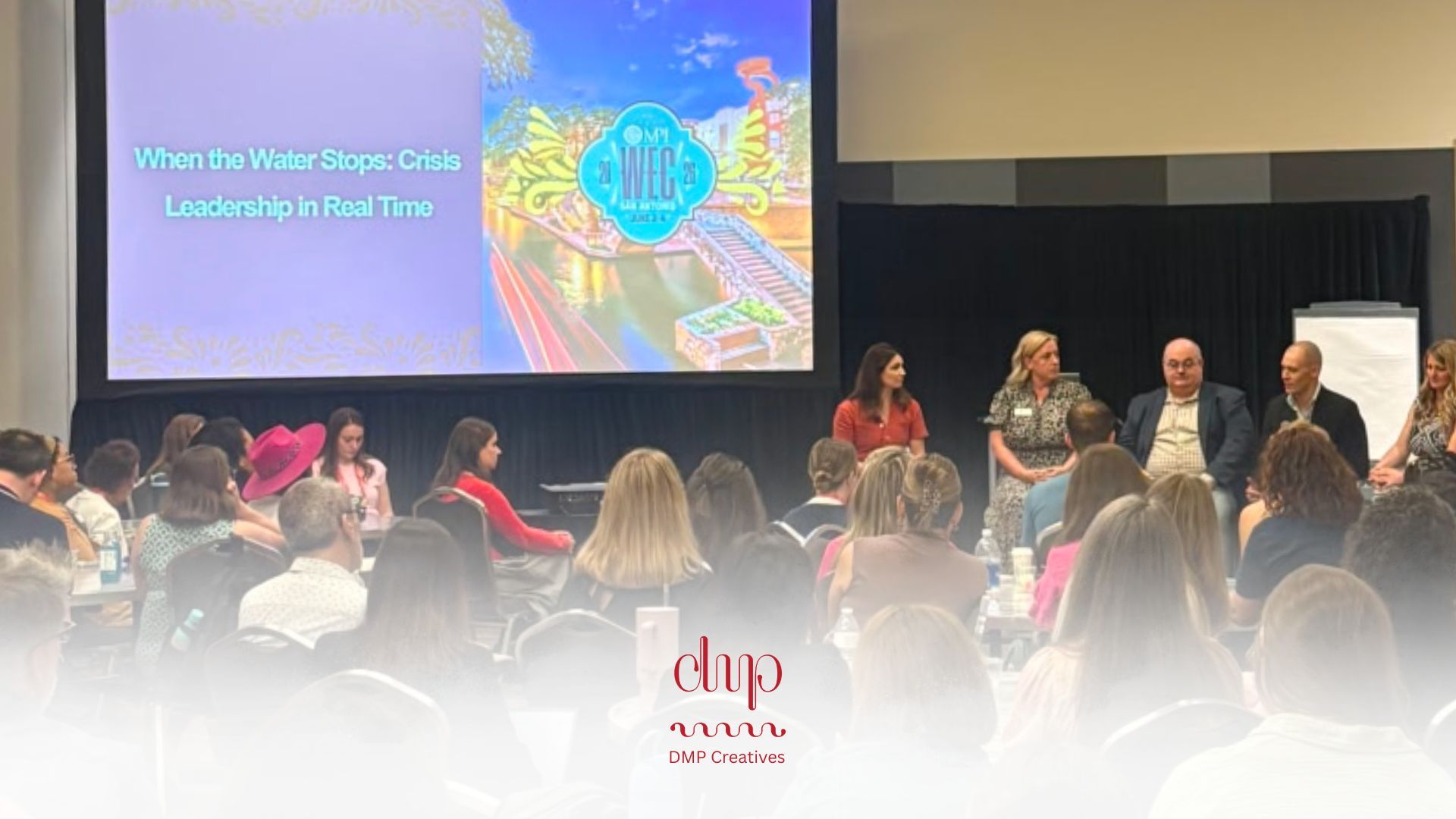
My last session at WEC was a crisis management simulation. I walked in with context. The night before, my hotel had no water. Along with a lot of my colleagues. In Texas. In summer. During a global conference. So when we sat down to talk about how event professionals handle disruption in real time, I wasn't pulling from a case study. I was pulling from the night before.
You figure it out. You have to. And walking into that session the next morning with that experience still fresh made everything we covered land differently — for me and for the room.
The biggest thing we worked through wasn't logistics or contingency plans. It was this: the difference between reacting and responding.
Reaction is where mistakes happen. Response is where leadership lives.
When something goes wrong at an event, and if you've been in this industry long enough you know it will, the professionals who serve their clients, their attendees, and their teams best are the ones who can pause, assess, and respond with intention. Not freeze. Not flail. Respond.
What made this simulation so powerful wasn't just the scenario. It was the revelation that most of us, under pressure, default to reaction before we even realize we've done it. The body speeds up. The words come out. The decision gets made. And then we're managing the consequences of a reaction instead of the outcome of a response.
That's a skill you can build. It lives in a set of questions you train yourself to ask before you act. A few beats of practice that become instinct over time. And it's available to you in real time if you've done the work to put it in your back pocket before you ever need it.
We left that room with those questions. I left thinking about how much of leadership comes down to exactly this one thing: the practiced ability to respond instead of react. Whether you're managing a venue crisis, a difficult stakeholder, or a session going sideways at 2pm, the skill is the same. Pause. Assess. Respond.
What 20 minutes proved
My SPARK session was the fastest one at WEC. Twenty minutes, 3pm, in a room full of event professionals who'd been in sessions all day.
I was adamant that fun and real learning could happen in that window. Not to prove a point, but because I know what 3pm does to a room. Attention is real. Energy is finite. If you can't earn it fast, you've already lost it.
We earned it.
By the end, the whole group was on their feet yelling "SPARK IT" together, and actually understanding how the SPARK Method changes the way people connect to content and to each other. We didn't just talk about it. We lived it. And in living it, we proved something I've believed for years and now had a room full of event professionals to back it up: fun is not a detour from learning. Fun IS the accelerator.
When the environment is energized, people absorb more. When they feel something, they remember it. When they're actively participating rather than passively receiving, the content lands in a way that actually changes behavior. That's not just good facilitation theory. That's neuroscience. And we were living it in real time at a conference full of the exact people who needed to see it work.
The reviews were great. But more than the reviews, the room proved the point. The container doesn't have to be big to produce something real. The design has to be right. Twenty minutes, done right, can change how someone thinks about their work. That's the whole game.
The neuroscience that validated everything
Full disclosure: I've been following Dr. Paul Zak's work for a while, and getting to be a student in his sessions at WEC was a highlight of my professional year. Full neuro-nerd fan-girl. Zero apologies.
What he's doing with biofeedback, using bio monitors to measure how people are actually feeling in real time during events, is the kind of thing that makes me want to never stop taking notes. But here's what hit differently: seeing the data confirmed what I've been designing toward for years.
When events are created with intention, when the energy is managed, when people feel psychologically safe and genuinely engaged, their bodies respond. We can measure it now. The feelings that good design produces aren't soft observations from satisfied attendees. They show up in cortisol levels, in oxytocin responses, in the physiological markers of safety and connection.
That's not a theory. That's confirmation that the work we do, the design, the facilitation, the intentionality, lands in people's bodies, not just their heads. It's also a challenge to every event professional in the room: if you can measure how your event makes people feel, what would your data say? What should it say?
I left those sessions more energized about the intersection of neuroscience and event design than I've been in years. Dr. Zak is the real deal. Getting to learn from him in person, after following his work from a distance, was worth every minute.
The work that meant the most
Before any of the sessions, before the selfies and the fan moments and the stage time, there was the launch of something we'd been building for months: the first edition of the new MPI Academy certificate course in partnership with Hilton.
We built this from the ground up. A real curriculum designed around conscious leadership, the kind of leadership that makes intentional choices instead of just executing habits. The kind that asks "what do I want to create here?" before "what do I need to do next?"
Hilton walked away happy, and that mattered. But what mattered more was watching the attendees engage in a way that was real and not performative. People made actual commitments. They identified specific places in their own leadership where they wanted to be more conscious, more deliberate, more present. They weren't just completing a course. They were beginning a journey.
That's what good design does. It gives people the conditions to see themselves clearly and choose something different. Watching it work for the first time, live, with a real room full of real people choosing to grow? That's the best feeling this job has.
The moments I'll keep
I got to assist with stage management at the Presidents Dinner, where Cleo Battle from Visit Louisville was celebrated. I've admired Cleo for a long time. He leads with both excellence and deep humanity, and the way he shows up for this industry, for his community, and for the people around him is exactly the kind of leadership the SPARK session and the Hilton course were designed to cultivate. Being in the room when the industry stopped to honor that felt significant. It reminded me why community matters. Why showing up for each other, not just the work, is part of what makes this industry worth being in. I was genuinely honored to be part of that night.
And then there was Wednesday. Jon Dorenbos opened WEC as the keynote, and I've been following his story for years. As an Eagles fan, I knew him on the field. As someone who pays attention to people who choose to turn hard things into something meaningful, I've admired what he's built since. Let me tell you: he is every bit as warm and open and honest in person as you'd hope. I got to hang out with him backstage after his session. He did a magic trick. Just for me. And in that moment I was fully, unabashedly a fan and I didn't care who saw it.
He didn't disappoint. He talked about his life the way someone talks about it when they've really done the work of making peace with it. There's a version of his story that could have broken him, and instead he made something extraordinary out of it. That's not a magic trick. That's response over reaction. That's the whole thing. #GOBIRDS
I also got to see Jim Kwik, whose work I deeply admire, and I spent real time supporting my colleagues at their sessions, which is one of the parts of WEC I genuinely look forward to every year.
What I'm bringing back
Response is where leadership lives.
Design is what makes 20 minutes matter.
The body keeps the score, and so does a well-designed room.
And the work is always, always worth it when the people in the room leave with something real.
Until next time, WEC. San Antonio was a good one.
Devon Montgomery Pasha is an executive emcee, facilitator, and experience designer. She helps organizations design and hold high-stakes events, leadership sessions, and signature programs. Learn more at dmpcreative.llc.