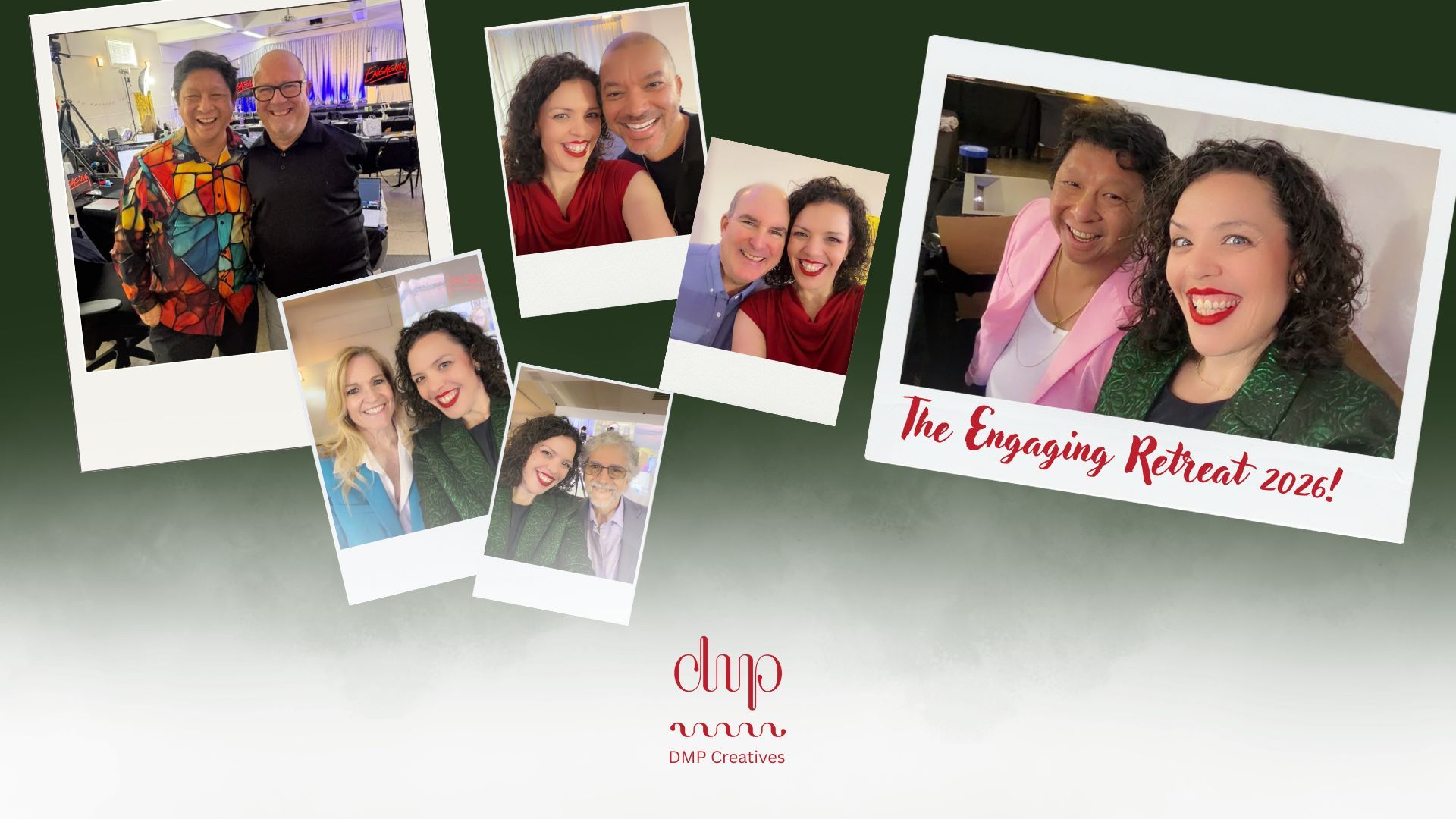
Three days at The Engaging Retreat turned out to be a masterclass in hybrid events, joy by design, and holding two audiences at once.
Last week I spent three days at The Engaging Retreat in Bothell, Washington, hosted by John Chen, CSP. It looked like a retreat for the speaking community. It turned out to be a masterclass in hybrid events.
Every time you peeled back a layer, there was another one underneath. It was a little like a really good trifle or parfait. Delightful on the surface, and then you keep digging and realize how much is going on below. What I found, layer after layer, was a masterclass in engaging events, in weaving together online and in-person audiences, and in designing for each of them individually and for both of them together.
Two audiences, designed for separately and together
Most hybrid events pick a side. Either the room is the main event and the online audience gets whatever is left, or the whole thing is a webinar with a few people in the corner. This one did neither.
The in-person audience and the online audience were each designed for on their own terms, and then designed for together. That is harder than it sounds. It means asking what each group needs in a given moment, and what they need from each other.
When it works, it comes down to small choices. Who gets greeted first. Where the energy is aimed during a transition. How a question from the chat is treated next to a question from the room. Those details are the difference between an online audience that feels included and one that feels like it is watching someone else's party.
Co-emceeing with a dedicated digital MC
I got to MC and co-MC this event alongside Jo Welch, who served as the dedicated digital MC, and she was amazing. Having someone whose entire job was the online experience changed what was possible. Our work intersected, and it also let each of us interact with our own audience individually, which I loved.
If you are planning a hybrid event, this is the part I would borrow first. Your online attendees do not need a camera pointed at the stage. They need someone who is actually paying attention to them.
Joy was part of the design
I talk a lot about how joy can be electric, and this event was a living example. Joy was not an extra here. It was built into the design. There were bubbles. There was a lip sync-a-palooza. There were hug times. There were small, individual moments of laughter for the people in the room and for the people joining from home.
None of that is filler. It is part of how people stay connected to each other and to the content, online or in person.
I have always believed that people remember how an event made them feel long after they forget the slides. Seeing joy treated as a real part of the program, for online and in-person participants alike, was a good reminder of that.
A front row seat to the craft
Every speaker brought their craft. That meant life lessons, and it meant getting to learn from great speakers while watching them practice what they teach. It also meant seeing some of the profession's Hall of Fame speakers do their thing up close, which is a different experience when you are in the room.
I got to open for several of them, including Marilyn Sherman, Elizabeth McCormick, Alvin Law, and Johnny Wimbrey. Not every MC gets that opportunity, and I do not take it lightly.
Standing in the room while someone at that level gets ready to take the stage is a reminder of what the job really is. An MC's work is to get the audience ready to receive the speaker, whether they are sitting a few feet away or watching on a screen.
The full lineup was a deep one. It also included Jim Spellos, Jacques Martiquet, Jim Harris, Dr. Ming-Ming Tung-Edelman, Dr. Robin Nussbaum and Zanielia Brown, Kathy Klotz, Janet Livingstone, Scott Cooksey, Tim Gard, Bruce Hill, Ivy Meadors, Luam Wersom, Theresa Francomacaro, and Adam Bacher, along with Jo Welch and John Chen.
What I am taking back to my own events
Three things are coming with me. First, design for each audience on its own terms before you design for both together. Second, give your online audience a real host instead of an afterthought. Third, build joy in on purpose, because it will not happen by accident.
The Engaging Retreat looked like a retreat for speakers. It was actually a working example of how to run an engaging hybrid event, and I am grateful I got to be inside it.
If you are planning a hybrid event, ask yourself one question. If your online attendees could only describe one moment from your event, what would it be, and did you design it for them?
If you are planning a hybrid event and want a partner who thinks about both audiences from the first design conversation, that is what I do. Let's talk about what your room, and your screen, need.
Devon Montgomery Pasha is an executive emcee, facilitator, and experience designer. She helps organizations design and hold high-stakes events, leadership sessions, and signature programs. Learn more at dmpcreative.llc.