
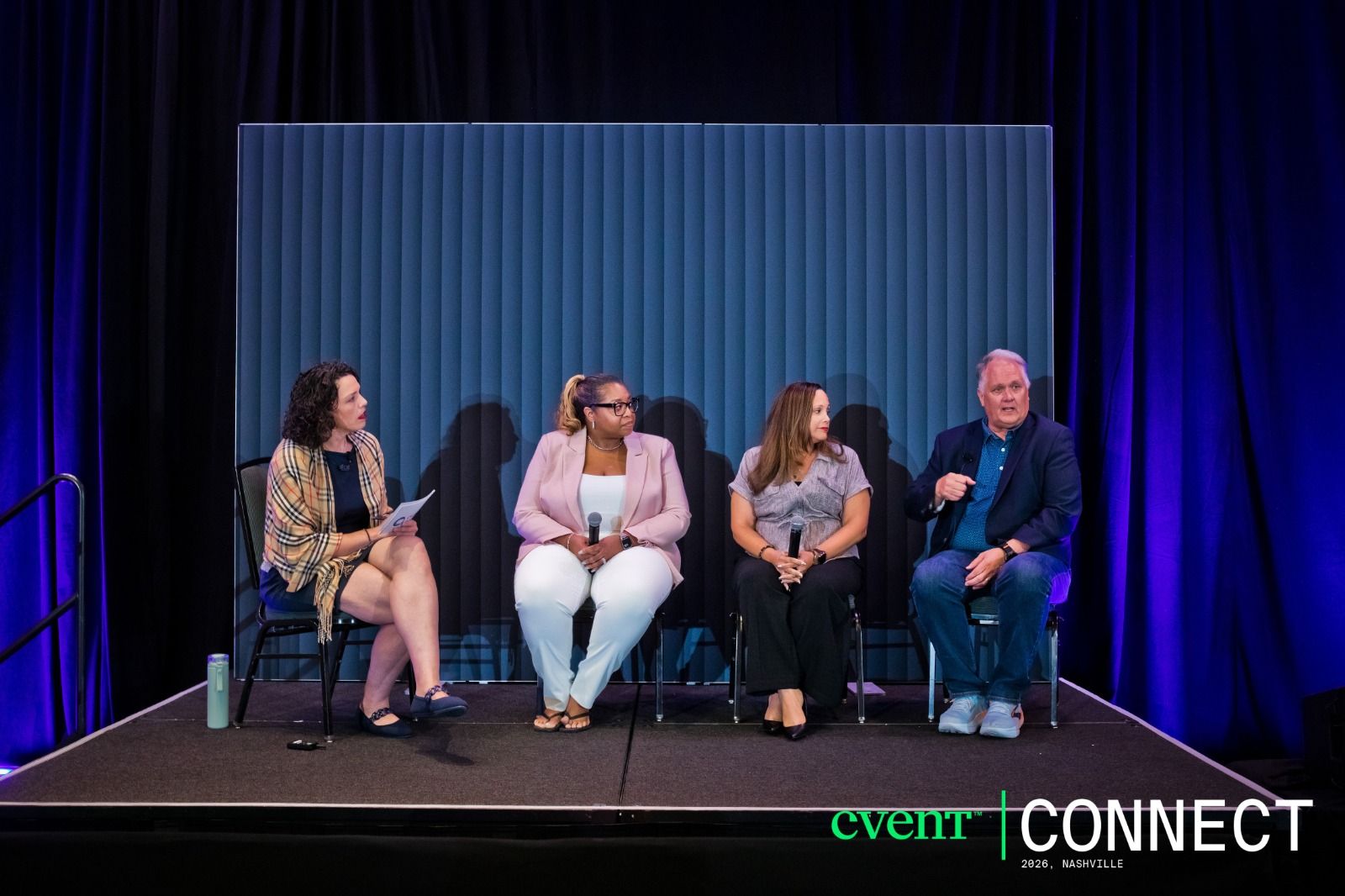
Three senior leaders, a Gen Z panel, and a rebrand that flipped an entire building overnight. Here's what Cvent 2026 confirmed about design and strategy.
The Question Underneath Every Agenda
I spent Monday at Cvent Connect inside a closed-door executive session with some of the most senior minds in Government, Higher Ed, Nonprofits, and Associations. About 40 leaders. No recording. No livestream. Just the kind of conversation that happens when you take the logistics talk off the table and ask something harder.
I was there alongside PCMA to facilitate, and I hosted three fireside conversations that I'm still turning over in my head.
The phrase I keep coming back to: to what end?
That was Joy King's phrase, not mine. But by the time the afternoon was over, it had become the question underneath everything we talked about.
Joy King: The Question Behind the Request
Joy is the COO at NCAN, the National College Attainment Network. She started as a high school English and Japanese teacher in Chicago, landed in operations because she's drawn to the infrastructure of how things work. She called it the "car chassis": the support structure people feel and sometimes hear, but don't see.
At NCAN, the chief program officer, the CFO, and the events manager all report to Joy. She sits exactly where the cases get made and the budget decisions get resourced. That's a view most event planners in the room had never heard from directly.
Her through-line: the question behind every event request is almost never asked out loud.
When someone says "I want a big reception," Joy's response is: to what end? Connect the event to the goal. Connect it to the KPIs. Connect it to the strategy. Otherwise you're not designing anything. You're just throwing a party.
She also said something I think about every time I work with a planner early in their career. "If you're not following the money, you're not growing in your career." The people who reach the top understand the dollars. Most people's financial savvy doesn't rise with their title, and that gap is a problem she works to close on purpose.
We also talked AI. Joy is NCAN's internal AI ambassador, and she framed it in a way I thought was sharp: we are operating in "an AI-saturated, low-trust environment." At events especially, human connection and credibility matter most. The real question isn't whether to use AI. It's how much to lean into it and how much to protect the human side, and whether you can do both in a way that feels credible to the people in the room.
John Bennett: Every Dollar Is a Donor's Dollar
John is from ALSAC, the fundraising and awareness organization behind St. Jude Children's Research Hospital. (They're two separate organizations, which surprises people.) He sits on the event operations and accountability side, not planning, and that distinction matters.
His frame on budgets: every dollar spent is a donor's dollar. That's not a tagline. That shapes how you look at every vendor relationship, every contract, every decision about what goes in the room and why.
He also talked about the operational reality of large-scale events planned two or three years out. Their largest brings around 1,900 people together. What does that runway make possible? A lot. What does it take to manage? More than most people expect.
The part of John's conversation that landed hardest: the industry is getting more serious about measuring the true cost and value of an event after it's over. Not just "did it go well." What did it cost, what did it produce, and how do you know? He sees that as a real discipline gap. So do I.
Kisha Powell: When the Landscape Shifts, You Go Ask
Kisha is the Chief Experience Officer at ACT-IAC, a nonprofit that brings government and industry together. When the federal landscape started shifting, ACT-IAC had to figure out who it needed to be for its members, fast.
Kisha's approach: she went and asked. Not a vibe check, not an assumption. Focus groups and a full member-wide survey, then sitting with the results to actually reshape what they offer.
Her framing on what members need right now: information, yes. But also to be in a room with other people who are in the same boat. The human connection piece isn't soft. It's the whole point.
Her team has also gotten serious about turning event data into real decisions. Pre-event surveys. Registration trends. Predictive tools that let you compare paid registration across years. She was watching Cvent's new AI announcements closely, which, given what was about to happen the next morning, felt like a real moment of foreshadowing.
The Bonus Panel: Gen Z Is Not the Problem
We added a 30-minute panel during the day and it turned into one of the best conversations of the afternoon. The premise: what can we teach Gen Z, and what can they teach us?
The answers to the second question were more interesting than the first.
Gen Z is teaching us the value of our time, if we're willing to see it that way. There's a habit in this industry that I call misery poker: one-upping each other with how much we suffer from our jobs. How many hours, how little sleep, how impossible the client was. For a long time that was a badge of honor. Gen Z doesn't play that game. And honestly, good for them.
What we can teach them: how to manage up, how to take criticism without shutting down, how to learn from a mistake and move forward instead of around it. Those are skills that come from experience, and they're worth passing on.
But the part I keep coming back to is this: if we're actually willing to listen to Gen Z in the room, their fresh perspective is exactly what we need to attract the next generation of audiences. They're not the problem to solve. They're the window into the room we haven't built yet.
And Then Tuesday Morning Happened
While 5,000 people were inside the main session watching Cvent announce their rebrand, the entire Music City Center rebranded. The balloons in the Exhibit Hall. The signage. Everything. They walked in knowing one logo and walked out to a completely different brand, executed across every surface of the building while they were captivated inside.
I was posting my own recap on Instagram and watched the Cvent logo on their account change in real time.
That's not a production win. That's a design decision.
Someone asked "to what end?" and answered it with an experience instead of a slide. The statement they wanted to make required a moment, not a memo. And they built that moment with precision: every piece timed, every surface covered, every detail swapped while nobody was looking.
Five thousand people can't stop talking about it. That's what design does when it's the whole strategy and not an afterthought.
What I'm Taking Home from Nashville
Three leaders who've earned the right to ask hard questions in rooms. A bonus panel that reminded me Gen Z has a lot to show us if we're actually curious. And a rebrand that proved, in real time, what it looks like when design thinking is baked into execution at every level.
The through-line I keep coming back to: every room has a question underneath the agenda. In Nashville, people were brave enough to ask it out loud.
What's yours?